
Negotiate Smart
★★★★★ 4.93/5 client satisfaction, measured by an independent auditor

The “Negotiate Smart” training module focuses on separating the convincing phase from the negotiation phase to achieve better agreement outcomes. After completing this program, participants will be equipped to prepare conversations effectively, define strategies, anticipate challenges, create scenarios, react wisely, and demonstrate creativity during negotiations. This training delves into key negotiation aspects, attitudes, preparation techniques, and various negotiation methods to empower participants to excel in commercial negotiations.
It is part of our DNA: sell the value first, negotiate afterwards. That is why, before launching a negotiation programme, we ask one question: is the value already established with your clients? If it is not, negotiating means defending a price nobody wants to pay, and we adapt the programme accordingly.
What makes a negotiation solid, before and during.
Participants will engage in a comprehensive analysis of their past negotiations, assessing both successful and challenging instances. By evaluating these experiences, they will gain valuable insights into the factors that influenced the outcomes and identify areas for improvement in their negotiation strategies.
This section will focus on understanding the dilemmas faced by parties involved in negotiations and their respective expectations. By delving into the motivations and concerns of the involved parties, participants will be better equipped to navigate through negotiation scenarios effectively.
Participants will explore how effective preparation can significantly impact the success of negotiations. They will be encouraged to utilize their commercial skills to plan for win-win scenarios, considering available knowledge, time constraints, and potential collaborative opportunities. This emphasis on preparation will equip participants to approach negotiations more confidently and strategically.
Through roleplays, participants will experience various negotiation attitudes and styles. This hands-on approach will allow them to recognize different approaches and understand the implications of adopting specific negotiation attitudes in different contexts.
Participants will navigate an extensive range of negotiation tactics, empowering them to identify, react, and creatively employ strategies in real-world negotiation scenarios.
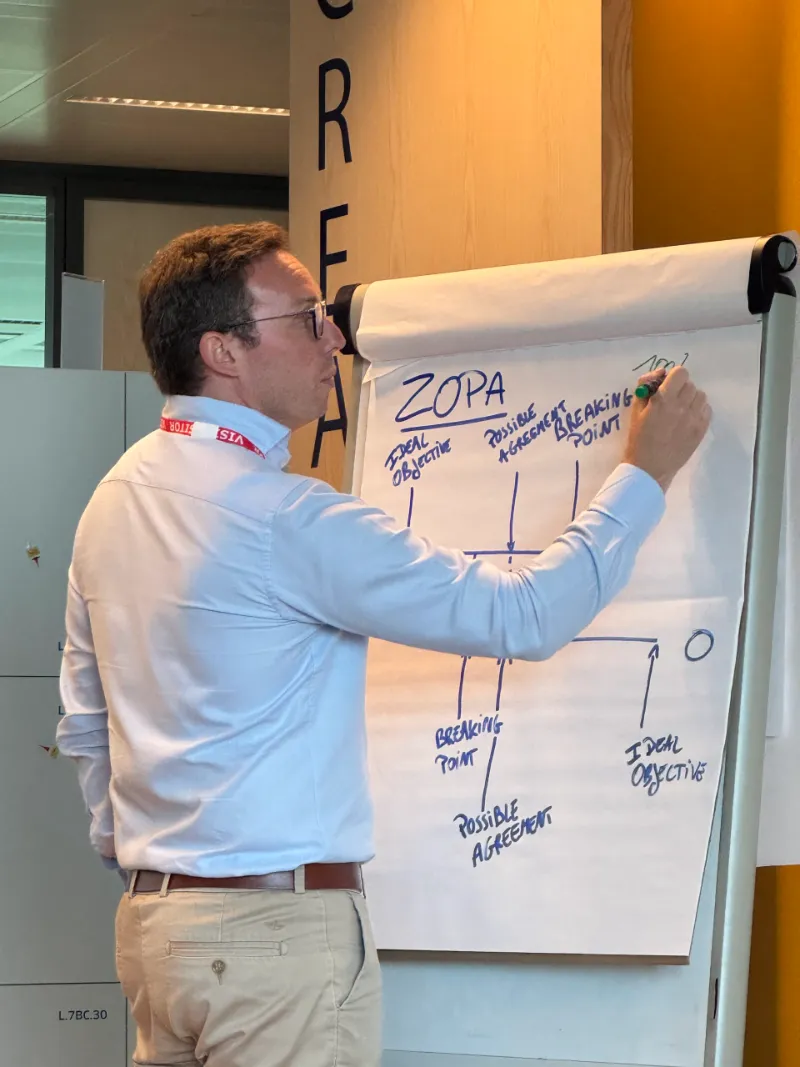
What your teams learn here, anticipating demands, targeting concessions, reading the zone of possible agreement and preparing the best alternative, only holds if what was conceded is recorded and reused. Otherwise, six months later, a colleague renegotiates with the same client, starts from a blank page, and concedes a second time. More is conceded, less margin is kept.
This is what we call the gearing: your people, your processes, your methods and your tools driving each other, with as little friction as possible. We work on this part separately, in advisory, before the training or after.
This module is one of the building blocks of the Sales Transformation Program, the programme that applies it for six months on your live opportunities and negotiations.
And on a real negotiation? Negotiation Coaching applies the method to your live negotiations, on the customer and purchasing side. Discover Negotiation Coaching
On site at your premises, in Belgium or abroad, remote or hybrid, in English, French or Dutch. Participants work on negotiations they are actually preparing.
Selling means convincing the client that your solution meets their need. Negotiation starts once they are convinced and you have to agree on terms. Negotiate Smart works on that second stage, often the one where margin is lost.
The training teaches how to anticipate demands, target possible concessions, read the zone of possible agreement faster and prepare your best alternative. What makes all of that fall away is that the concessions granted are recorded nowhere: the colleague who renegotiates with the same client starts from a blank page, and concedes a second time what had already been conceded. More is conceded, less margin is kept. The remedy is a process, not a training refresher. This is what we call the gearing: your people, your processes, your methods and your tools driving each other, with as little friction as possible. We work on this part separately, in advisory, before the training or after.
By knowing, before you walk in, what the other side will ask for, what you can concede and what you will not concede. Preparation comes down to four questions: which concessions are possible and which cost too much, where the zone of possible agreement sits between your limits and theirs, what your best alternative is if no agreement is reached, and which tactics you expect across the table. The module has you review your past negotiations to find those levers, then practise them.
By conceding in a targeted way rather than as you go along. Most margins are lost on concessions made by reflex, to soothe, with no counterpart and no record. Anticipating demands lets you choose in advance what you give, in exchange for what, and at what moment. The relationship does not suffer, quite the opposite: a counterpart has more respect for a partner who knows what they are worth. The module adds a survival guide to the negotiation tactics you meet most often.
Discover our methodology
Valorize your team and unlock their true potential. Contact us to schedule your transformative training.