“Can you do something on the price?” “We need the delivery by Monday.” “Your competitor is offering us a better deal.” Every day, your salespeople receive requests where the right answer is no, or yes on other terms. Many say yes while thinking no, to protect the relationship. Others dig in their heels, and the relationship pays the price.
Assertiveness is the third way: calmly saying what you think and what you need, genuinely listening to what the other person needs, and looking for the point where you can meet. With respect for yourself and respect for the customer.
This one-day module works on both sides of the skill. The inside: what happens when the pressure rises (beliefs, emotions, stress reflexes). The outside: refusing, reframing, giving feedback, making a request. It extends Value Drive, Negotiate Smart and Elevate Conversations: defending your value, negotiating and elevating the conversation all start with daring to hold your position.
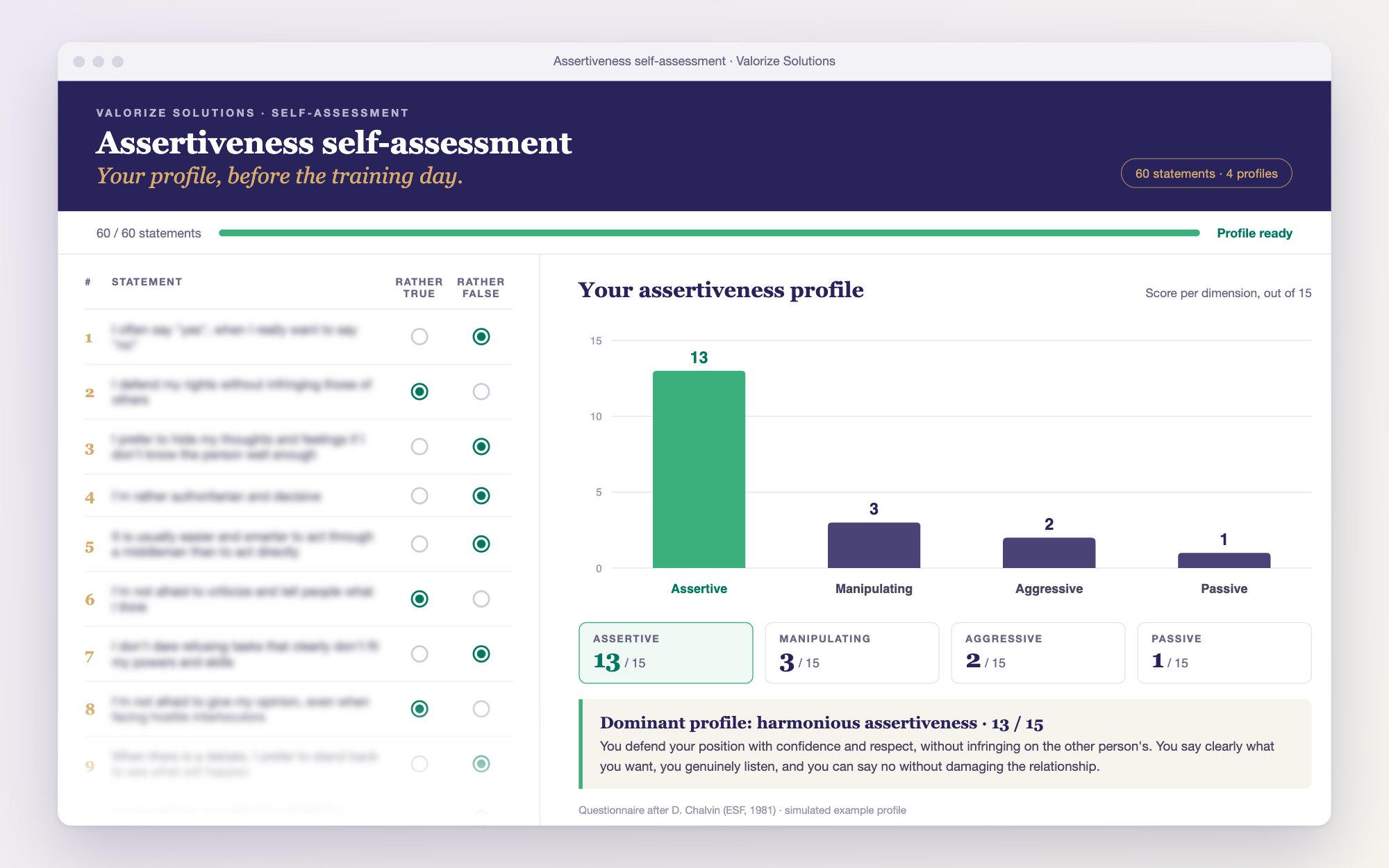
Before the training day, each participant answers 60 statements, rating each one “rather true” or “rather false”. The result places their profile on four dimensions: assertive, manipulative, aggressive and passive. That profile becomes the starting point of the day: everyone knows where they start from, and what they are working towards.
Assertivity for Sales extends three of our modules.
Dominate, manipulate, give in, or assert yourself while listening to the other person. The four attitudes are compared on the same customer situation, starting from each participant’s profile. A four-level scale then shows the path: from reactive assertiveness (I say no when asked) to proactive assertiveness (I put my position forward spontaneously), up to assertiveness in tense situations (I hold my position under pressure, without running from the disagreement).
Between the customer’s request and the salesperson’s answer sit a belief (“if I say no, I lose the deal”) and an emotion. The ABC model from cognitive behavioural therapy makes this mechanism visible. Participants explore their perception filters, the six basic emotions and what each one is for, their stress reflexes (fight, flight, freeze, appease) and what builds or destroys trust in a business relationship.
Behaviour breeds behaviour. With Leary’s Rose, transactional analysis (Parent, Adult, Child) and the “I’m OK, you’re OK” position, participants see how a dominant buyer pushes the salesperson into submission, and how to return to an adult-to-adult relationship. The drama triangle (persecutor, rescuer, victim) and its alternative (creator, challenger, coach) offer a simple marker for relationships that get stuck.
The rights everyone can grant themselves (saying “I don’t know, I’ll get back to you”, changing your mind in light of new information, saying no without guilt). The STOP method to take back control from the autopilot. The DESC method to frame a correction. Nonviolent communication for charged exchanges. The three types of feedback (positive, constructive, corrective) and the seven steps to saying no. Finally, the Thomas-Kilmann model to choose between competing, collaborating, compromising, avoiding or accommodating, depending on what is at stake.
Each participant brings a situation they are facing right now: a customer demanding a discount, an impossible deadline, an aggressive counterpart, an internal promise that was broken. The situation is analysed (context, cause, risks, solution), then replayed with the tools of the day. The day closes with a personal commitment: the next concrete step in daily practice. Four to six weeks later, the anchoring session reviews the situations actually faced: what held, what gave way, and why.
Aggressiveness defends its own interests without listening to the other person’s; passivity listens to the other person and forgets its own. Assertiveness does both: it states its position and needs clearly, genuinely listens to the customer’s, and looks for the point where both can meet. In sales, that is what lets you hold a price or a limit without damaging the relationship.
Before the training day, each participant answers 60 statements, rating each one “rather true” or “rather false”. The result places their profile on four dimensions: assertive, manipulative, aggressive and passive. The profile is the starting point for the work done in the room.
Value Drive builds and quantifies the value; Negotiate Smart prepares and conducts the negotiation. Assertivity for Sales works on what happens in between: daring to hold your position when the customer applies pressure. The module can be taken on its own or as an extension of either journey, or of Elevate Conversations.
Discover our methodology
Dare to say it, dare to refuse, dare to ask.
Contact us to schedule your "Assertivity for Sales" today.