Coaching · Integrated programme
A programme built around the opportunities and negotiations your people already have on the table.
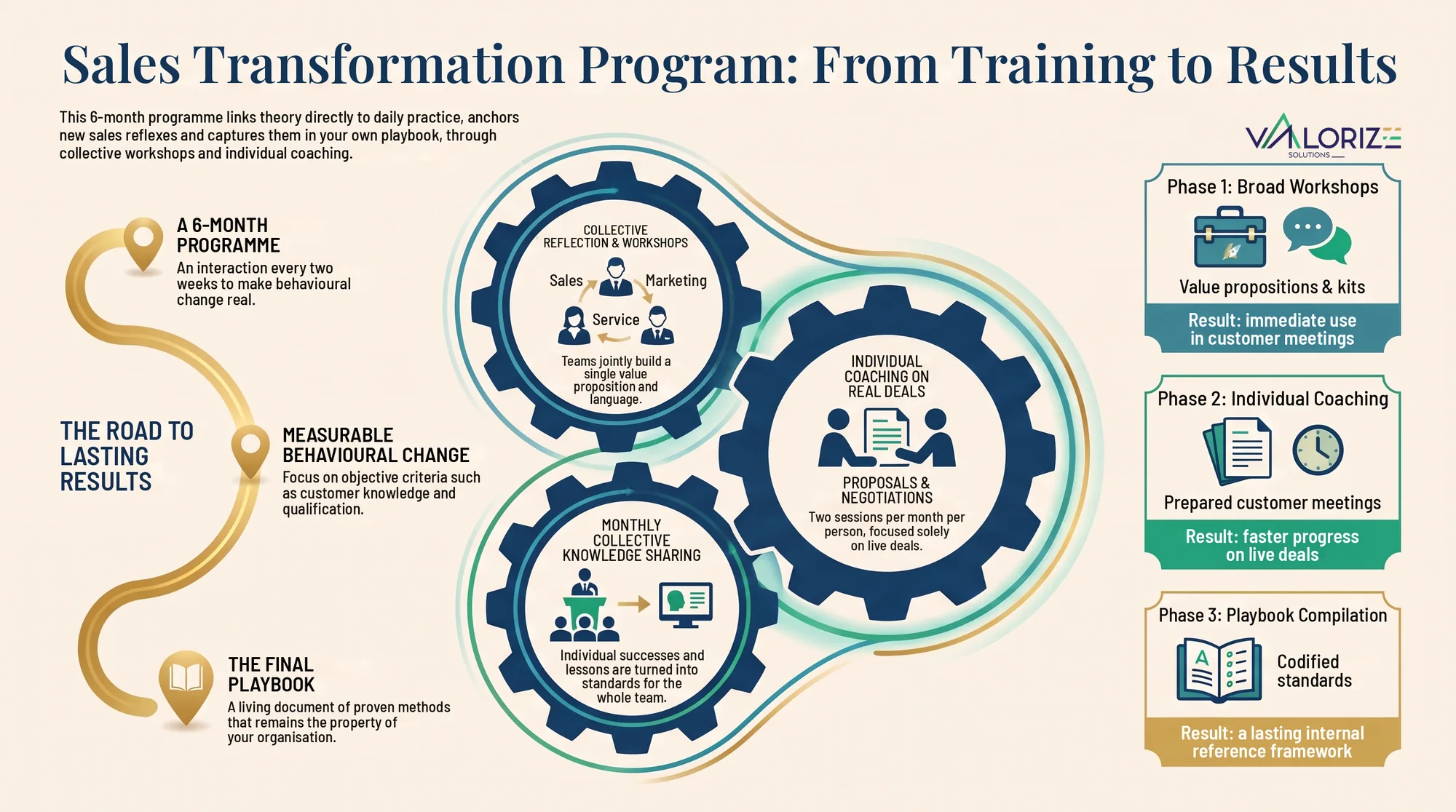
Three rhythms that feed each other: broad workshops where the organisation builds its own way of selling, individual coaching on each salesperson's real deals, and monthly group sessions that bring what the individual work uncovered back to everyone. Six months, one session every two weeks per person, and a playbook that stays with you.

A training course installs a shared language in two days. What decides its effect is the Tuesday that follows: the meeting being prepared, the quote being defended, the renewal negotiation coming up. That is where transfer of learning happens, and that is where most programmes stop.
This one takes the problem the other way round. The group work installs the structure and the vocabulary. The individual coaching applies them straight away, on the files each person actually has in front of them. And what the individual work produces comes back to the group, so that what one salesperson found serves the others.
The six other programmes in our catalogue are organised around an audience or a theme. This one is organised around your opportunities.
We claim observable behaviour change. Commercial results depend on too many factors that neither you nor we control, and we read them at the review without promising them.
Sessions that bring together the salespeople, and also the people who carry the processes and those responsible for the tools and their rollout: pre-sales, product, marketing, customer service, inside sales. A way of selling that has to be visible in what the client receives cannot be built by the sales team alone.
Two sessions a month per person, on their accounts, their opportunities, their negotiations and what blocks them. Never a textbook case. The coaching covers the person, their method, and the file in front of them at the same time.
Every month, two hours that carry the individual work back into the team: what one salesperson tried on a deal becomes the team's tool. A concept useful to several people is explained once rather than five times, and peer coaching takes hold.
These three rhythms are not three services placed end to end. They are timed against each other, and each one depends on what the previous one produced.
No step is delivered in isolation. Every interaction produces something the next one uses, and the standards grow out of that movement.
| The moment | What it produces | Where that goes next |
|---|---|---|
| Opening interviews and pipeline review | A measured starting point and a first hypothesis about the method | Shapes the content of the workshops and the coaching priorities |
| Broad workshop | Value arguments, business case, proposal kits, first prompts | Used with clients the next day, reviewed with pre-sales |
| Shared method day | A decision-maker map, a qualification and a first account plan per participant | Becomes the subject of the first coaching cycle |
| Individual coaching session | A meeting prepared or debriefed, a plan updated, an observation against the standard | Feeds the next session, the account plan and the drafting of the standards |
| Client meeting attended | A structured debrief on what worked in front of the client | Adjusts the person's development plan and the team kits |
| Session with the supporting teams | The check that the method is visible in the material clients receive | Adjusts the structure of proposals and the handover |
| Monthly steering debrief | An aggregated view, agreed actions and their owners | Adjusts the pace, the priorities and the scope of the next cycle |
| Playbook compilation | The codification of what actually worked | Read by the team, validated internally, it becomes your reference |
| Final review | The gaps measured against the starting point | The priorities for the next cycle, if there is one |
The order matters. You only qualify, plan and negotiate well what you know how to make valuable. Without the first block, the account plan stays a spreadsheet and the negotiation turns into a discount.
The shared grammar of the value conversation: structured questioning, listening, quantification, business case, objections, closing. Built in the room on your real offers and your real accounts, with the people who will have to carry it. This is where the first pages of the playbook come from.
The working frame per account: the decision-maker map, the activity plan, deal qualification, offensive and defensive portfolio management. Explained once as a group, then applied immediately in sub-groups on each person's own accounts.
Six months on real files, with the return to the group every month. This is the bulk of the programme, and it is what separates a language people have learned from a reflex they have acquired.
When the team is ready, usually in the second half of the programme, on negotiations that are genuinely live: renewals, margin defence, trading currencies.
Always the same structure, always on a real file. We coach on four levels: the person's skills, their method, the application of the standards the team has co-written, and what practice with clients sends back to those standards.
The session is turned into a structured note that belongs to the person being coached. It becomes their development plan, without judgement. Two self-coaching grids come with it, which they end up using alone, before a difficult meeting or after a disappointing one: the first one reads the situation, the second one helps to decide. These are the coach's questions, handed over to be used without him. And an application task calibrated for a busy week.
This is the moment that changes the most, and the most demanding one. The coach prepares the meeting with the salesperson: the written objective, the decision-maker map for that account, the two questions they want to ask and the silence they want to hold.
During the meeting, the coach is introduced to the client as what he is. He observes and does not step in.
The debrief happens the same day: first what the salesperson saw themselves, then what the coach observed, then the write-up and the next step recorded before they part. The debrief joins the person's development plan.
You already have people, processes under construction and tools arriving. What is usually missing is what connects them. A CRM without a routine stays a licence. A method without a tool stays a memory of a training course.
During the programme, the method goes into what your teams already use: the preparation templates, the review grids, the analysis instructions in your assistants, the format of the write-up. We bring the ideas and the method, we build them with your teams, and the technical implementation stays with you.
This is the full reasoning behind our integrated approach. It is explained in detail, with the animated engine, on our Commercial excellence page.
See the integrated approachA starting point is taken before anything begins, and taken again at the final review with the same counting method. In between, we count behaviours. The examples below come from a long-cycle B2B portfolio, and they are set with you.
This rule is written down before the programme starts. It protects the trust that coaching on real files depends on, and without that trust nothing happens.
In learning and development terms: we work at Kirkpatrick level three, transfer and behaviour change. More modest than promising a business result, and far easier to verify.
A programme that stops when the coach walks away has changed nothing. What follows is in place before the end, and holds without us.
A handover session closes the coaching period: how to coach against the standard, how to keep the playbook, how to onboard a newcomer with the existing material. After that we are no longer in the room.
The programme is never bought off the shelf. It follows the seven steps we apply to all our programmes: framing and governance, intake interviews, studying your business, building the programme and its materials, pilot group, rollout, then anchoring and applied follow-up.
The three forms of coaching in our catalogue are the building blocks of this programme. You can take one on its own if that is what your team needs. The programme combines them and adds the group work, the measurement and the playbook.
It is there to work out whether this programme makes sense where you are. We look together at your sales cycle, the size of the team, what has already been tried and what is stuck today. If a different answer fits better, one module on its own or occasional coaching, we say so.
Curious to see what this would look like with your team?
One conversation is enough to place your sales cycle, the size of the team and what is stuck today. If a lighter answer fits better, we say so.