

Sales Management Development Program
The Sales Management Development Program is our sales management training, run over 9 to 12 months. It is designed for everyone who leads salespeople: team leaders, district managers, sales managers, sales directors and, at the top, CROs, CCOs or CGOs. Every session starts from your salespeople, your numbers and the rituals you already run.
Companies promote their best salesperson, then ask them to coach. Nobody has taught them how. Promoted for their results, they repeat what they know how to do: give advice, take over the difficult deal, decide on the salesperson’s behalf.
The number arrives too late. Managing the result alone means discovering the problem the following quarter, when there is no time left to recover.
The tools are there, the habit is missing. CRM, conversation recording, AI assistants: without a ritual that puts them to work, they are just licenses.
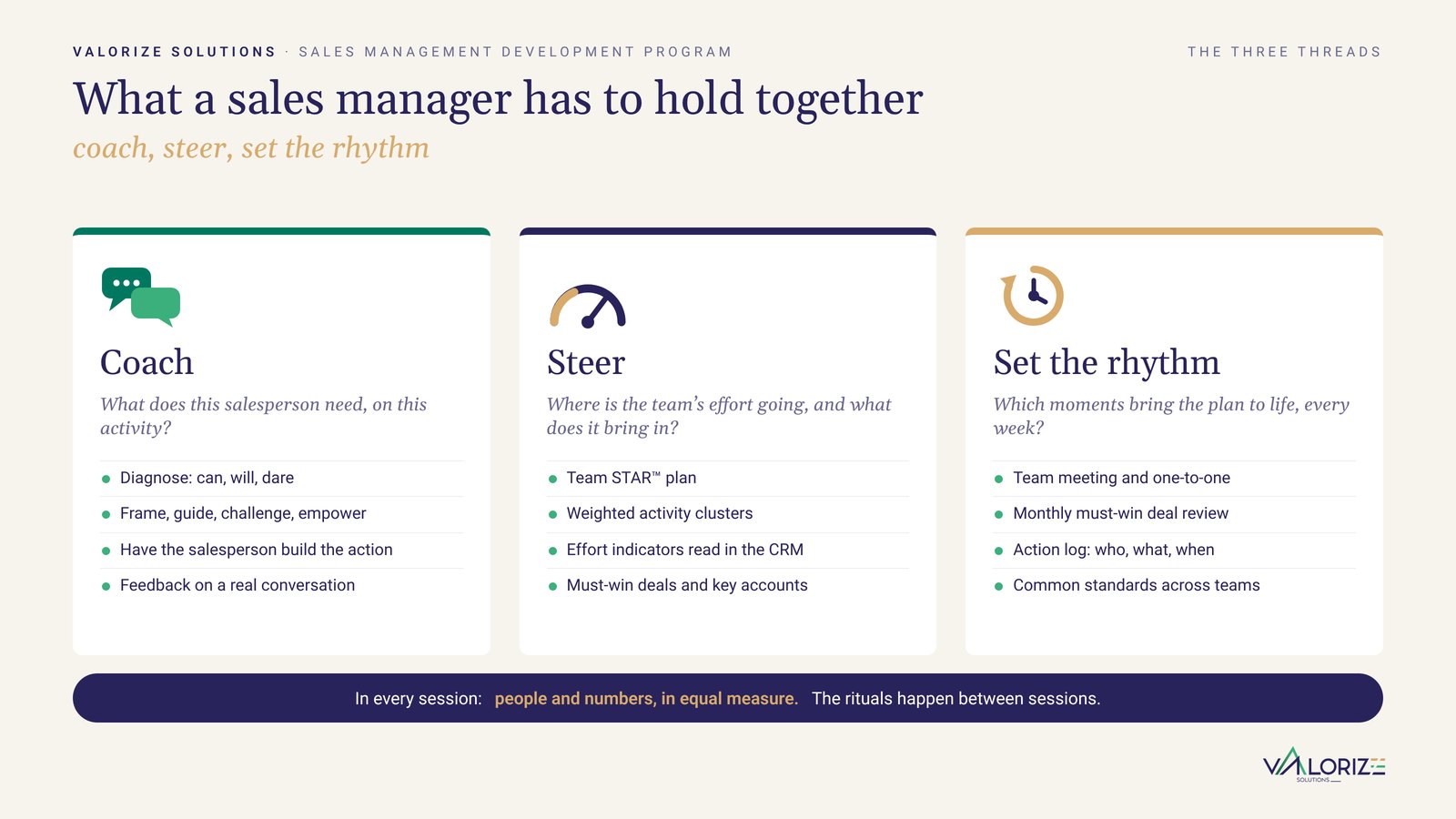
The program tackles all three causes in the same sessions: the coaching posture, steering the effort, and the rituals.

Most providers sell the coaching posture on one side and sales steering on the other. We work on both in the same room, because neither holds up without the other. A manager who knows how to ask questions but has no plan and no rituals slides back into firefighting. A manager who steers without coaching ends up chairing reporting meetings.
Two levels, one system

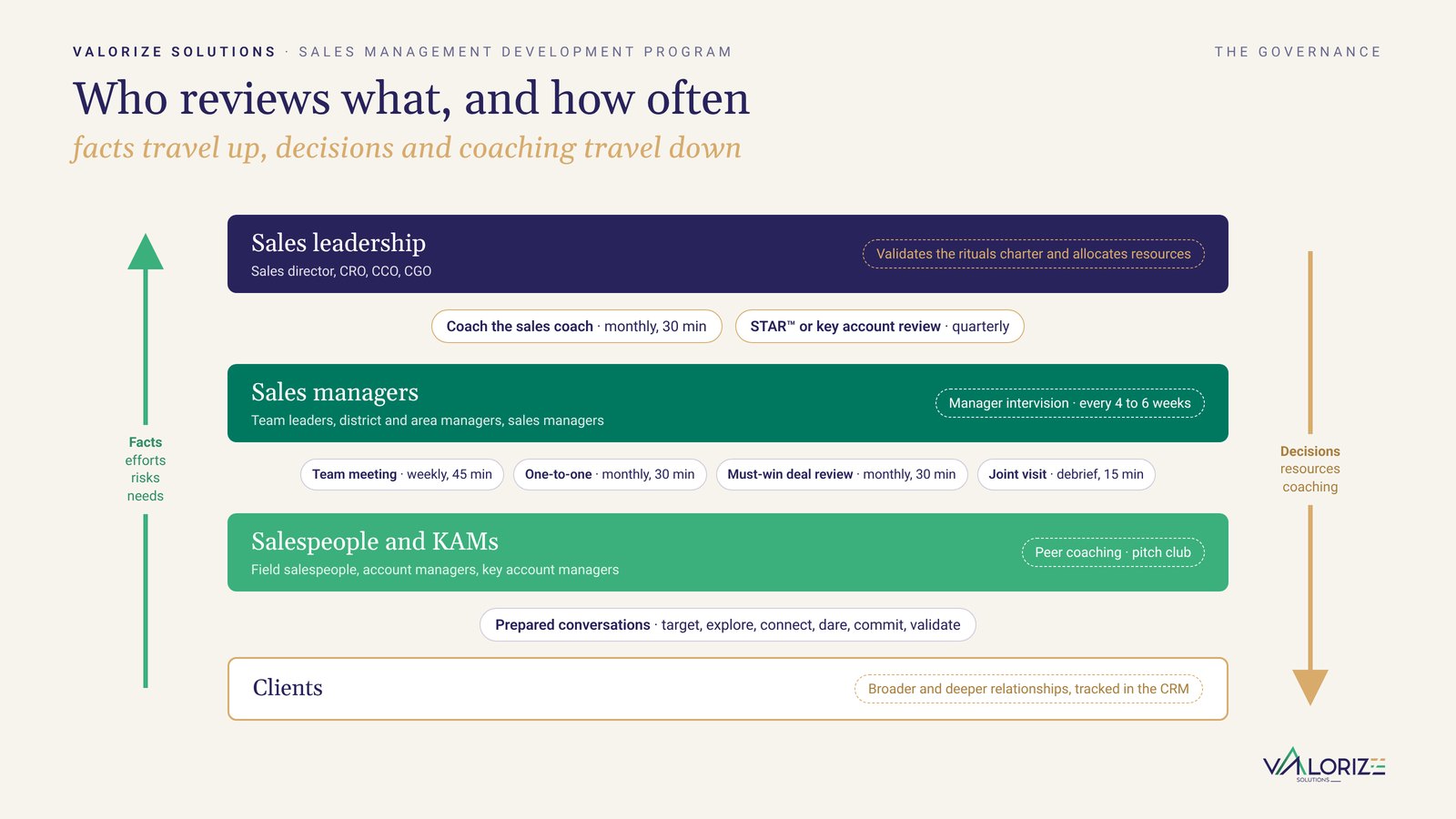
Useful commercial governance answers one simple question: who reviews what, and how often. Facts travel up, from the client conversation to senior leadership. Decisions, resources and coaching travel down.
Managers design their own rituals, starting from a blank page, then align them across teams. What is common to all teams goes into a charter; what each team adapts stays local. A standard imposed from above gives way to local habit as soon as leadership looks elsewhere. That is why the managers write it themselves.
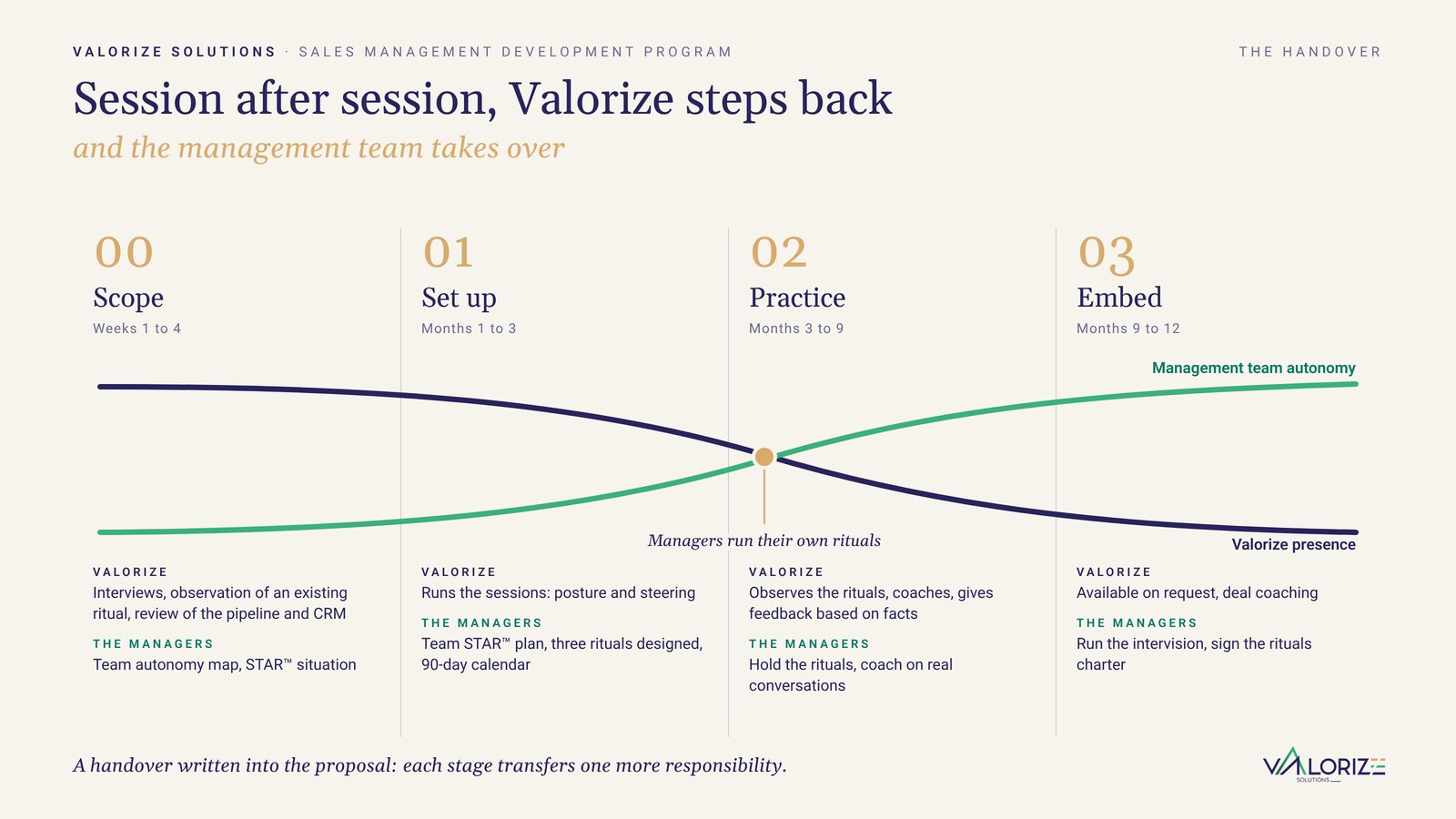
00 · Scope (weeks 1 to 4). Interviews with leadership and managers, observation of an existing ritual, review of the pipeline and the CRM. Each manager prepares their team’s autonomy map: for each salesperson and each key activity, what they can do, want to do and dare to do. Scoping is included in the program.
01 · Set up (months 1 to 3). Session 1: diagnose people and structure the effort, with the team’s STAR™ plan. Session 2: grow autonomy and design three priority rituals, with a 90-day calendar.
02 · Practice (months 3 to 9). Session 3: give feedback based on the recording of a real conversation. Session 4: challenge without taking over, and the must-win deal review. Session 5: key accounts and the client ecosystem, with the decision-making unit map (who decides, who influences, who blocks). Between sessions: individual coaching, observation of a real ritual with feedback, manager intervision (a real case worked through among peers).
03 · Embed (months 9 to 12). Session 6: each manager presents a case, the year is reviewed against the indicators, and the standards become a rituals charter. The managers run the intervision themselves; we remain available on request.
Session after session, Valorize steps back and the management team takes over. From the proposal onward, we write down who takes over what, and when.
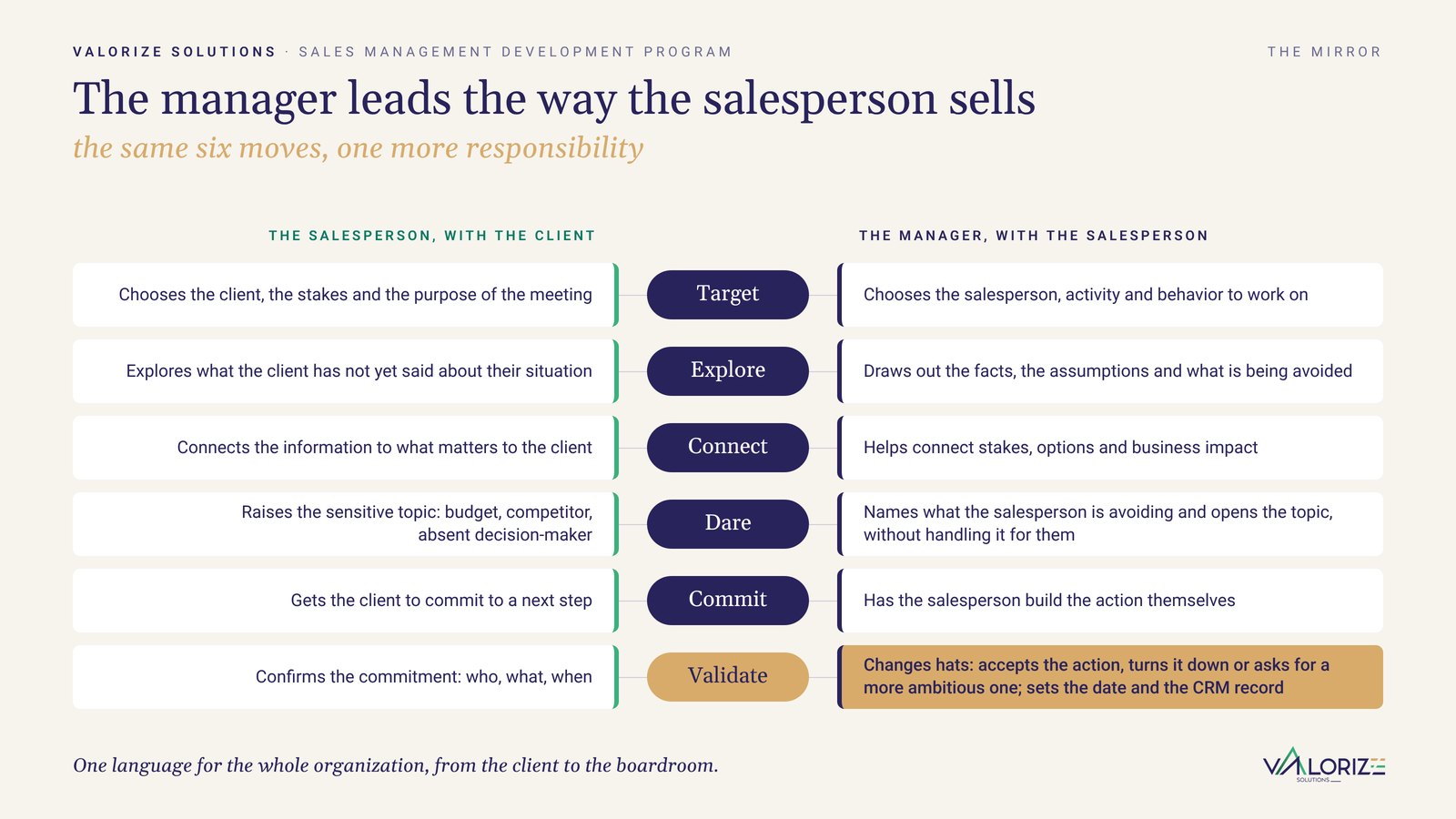
The salesperson targets the client, explores what they do not yet know about the client’s situation, connects that information to what matters to the client, dares to raise the sensitive topic, gets the client to commit to a next step and validates that commitment. The manager makes the same six moves with the salesperson, with one added responsibility. At the validation step, the manager changes hats: they accept the proposed action, turn it down or ask for a more ambitious one.
This is what links this program to our programs for salespeople. Managers coach in the language their teams learned with Value Drive and Enrich Conversations.
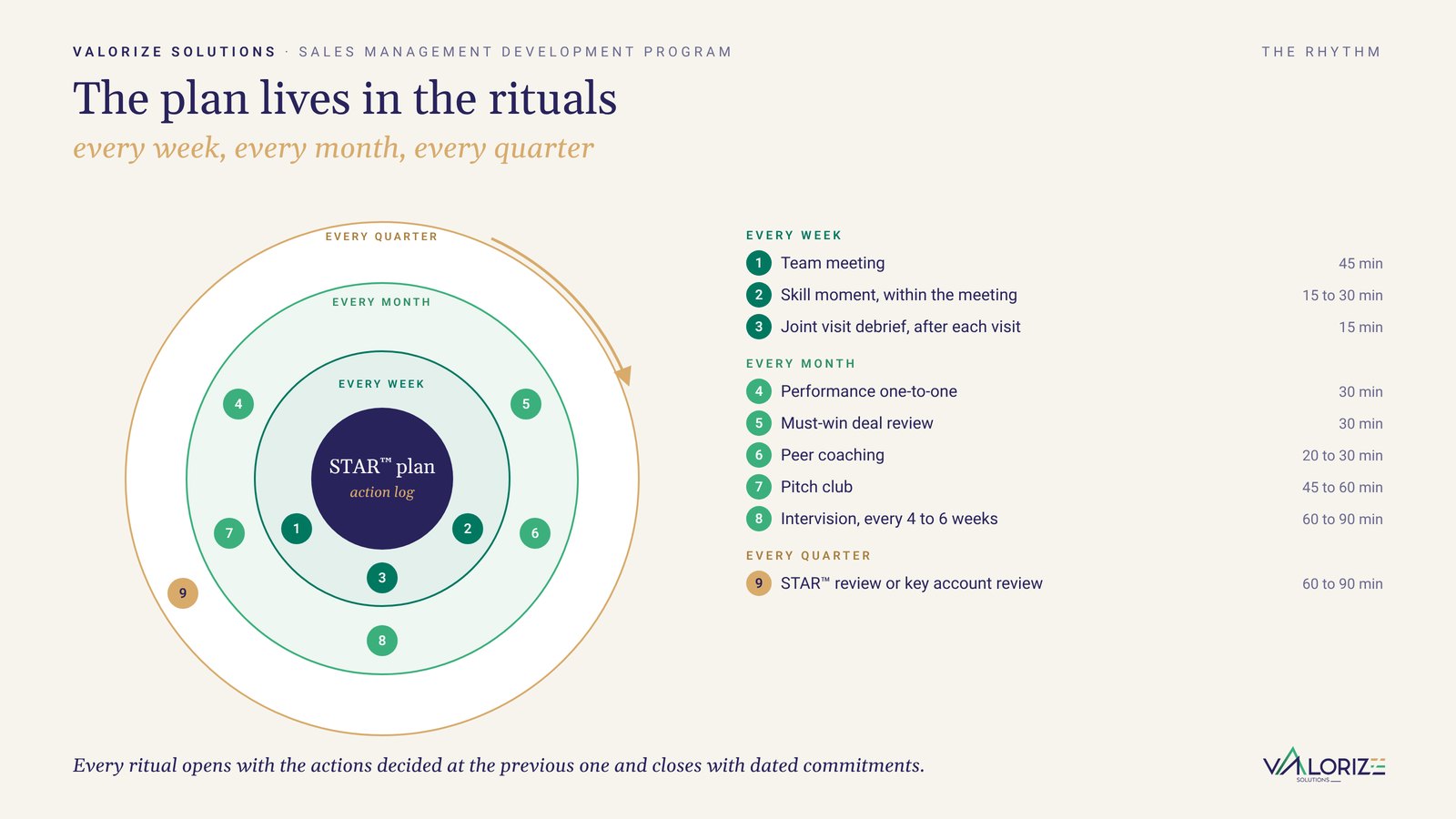
Each team starts with three. The method is detailed in the Sales Steering & Rituals module.
Session 1: diagnose, on a specific activity, what each salesperson can do, wants to do and dares to do, starting from the autonomy map prepared during scoping, then choose the intervention that fits (frame, guide, challenge or empower). Each manager then builds, from a blank page, a first version of their team’s STAR™ plan: the direction of effort, a few focus areas and the effort indicators chosen during scoping.
Session 2: grow autonomy. The manager learns to choose between four hats (train, mentor, coach, direct) and to say which one they are wearing. They hold a coaching conversation that is recorded and then debriefed: in the room, remotely or with a salesperson from their own team, whichever suits the group. Finally, they design three priority rituals, each with its own action log (owner, expected result, date, status), and a 90-day calendar.
Session 3: give feedback based on the recording of a real conversation, grounded in observable behaviors.
Session 4: challenge without taking over, first with a salesperson who pushes back, then in the must-win deal review, which the salesperson leads and where the manager challenges.
Session 5: dare to have the conversations people avoid most, the salesperson’s with the client as well as the manager’s with the salesperson. The session also covers key accounts and the client ecosystem, with the decision-making unit map: who decides, who influences, who blocks.
The weight given to each theme is agreed with leadership during scoping, based on what is at stake for the teams.
Session 6: each manager presents the case of a salesperson they have supported. They describe the starting behavior, the intervention they chose, what has changed and where resistance remains. The end-of-program review covers the four levels of measurement: leadership, rituals, behaviors and results.
Together, the managers write and sign the rituals charter, which sets out what is common to all teams, and each of them makes a commitment for the following 90 days. In the final months of the program, the managers run the intervision themselves; Valorize remains available on request.
Between sessions, each manager puts the work into practice in their team’s rituals. Three forms of support go with them:
On the sales leadership side, each leader in turn coaches their own managers in a 30-minute monthly check-in.
For follow-up, we use AI and transcription tools, with participants’ consent: meeting notes, action logs and session preparation go faster, and judgment stays with the manager.
As an add-on, billed separately: deal coaching or opportunity coaching on a key deal, or tailored individual coaching. A single intervention then serves the deal, the salesperson and their manager.
Leadership: the share of management conversations that focus on a specific activity and behavior, and the share of actions formulated by the salesperson. Rituals: meetings and one-to-ones held over 90 days, decisions logged, commitments delivered on the agreed date. Behaviors: the four effort indicators (preparation, exploration, progression, execution), read in the existing CRM. Results: the business indicators chosen during scoping, for each activity cluster.
The first three levels can be measured from the first weeks. Results follow with a delay, and we measure them all the same.
Who facilitates. The Valorize team that already supports sales managers, including Isabelle Wats, Ethel Druart, Joëlle Verbeurgt, Mathieu Swine, Fabian Tempels, Matthias Köhler and Vincent Flament. To go further: Deal Coaching, Leadership Coaching and, on the Advisory side, our “Design commercial governance” and “Support the deployment” offers.
With three things, in this order: look at where each salesperson stands on their key activities, set three team rituals, and hold those rituals every week. The promoted top seller’s reflex is to take over the difficult deals personally; it helps in the short term and holds the team back later. The program starts with an autonomy map of the team, prepared by the manager and validated against facts.
By choosing your intervention based on what the salesperson can do, wants to do and dares to do, on a specific activity. Four interventions cover most cases: frame, guide, challenge, empower. The manager asks the questions, the salesperson builds the action, then the manager validates it, turns it down or raises the bar.
By building coaching into moments that already exist: the team meeting, the joint visit debrief, the monthly one-to-one. A joint visit debrief takes 15 minutes, a skill moment in a meeting 15 to 30 minutes. The time saved then comes from salespeople coming back for answers less often.
Training means passing on a method; mentoring, sharing your experience; coaching, drawing the solution out of the other person; directing, setting the frame and the standard. A sales manager wears all four hats. The skill that makes the difference is knowing which one to wear, and saying so.
By keeping it to 45 minutes and giving it an output: dated commitments. It opens with last week’s action list, reads the efforts in the CRM, settles one priority topic and closes on who does what by when. The more participants there are, the shorter and more selective the meeting needs to be.
Thirty minutes in three parts: efforts compared with the facts, a diagnosis of the obstacle, then the action. The obstacle is one of method (they don’t know how), motivation (they don’t want to) or nerve (they don’t dare), and each calls for a different response. The salesperson proposes the action; the manager locks it in with a date and a written record.
By separating the facts, the interpretation and the belief that holds them back. “I’m not going to bring up their other sites, they’d think I’m too pushy” is a belief, and it can be worked on through questions. The manager challenges without taking over, and knows how to say no to an action that is too weak.
By tracking effort indicators that the team has chosen with its manager and reads for itself in the CRM. They can be read from the first week, well before revenue moves. The rule set from the start: a recording or a dashboard is there for learning, and it belongs first to the person concerned.
By agreeing before the visit on what you will observe, staying silent during it, and debriefing within the hour. The debrief follows the seven coaching questions: the situation, what the salesperson really wants, their options, what they need, their decision, their first action and their commitment. The salesperson finds the answer; the manager writes it down.
By setting aside 15 to 30 minutes of every meeting for an exercise on a real case, prepared by one or two salespeople. The manager assigns the work in advance, runs the exercise and records what works. Without the manager carrying it forward, the method fades within a few months, and newcomers never learn it.
Because nobody has taught them how, and no moment in their week is set aside for it. Many were promoted for their results as salespeople and repeat what they know how to do: advise, take over, decide. The program gives them the posture and the rituals that make it happen.
By measuring rituals held and decisions logged, team by team. A ritual that actually takes place leaves a trace: an action log with owner, date and status. The quarterly review goes back over these traces and the rate of commitments delivered.
Effort and quality indicators: meetings prepared with a written objective, opportunities enriched with new information, meetings that end with an explicit ask, actions completed on time. They are chosen during scoping, in the existing CRM, with no extra data entry where possible. Revenue reacts later; it is still tracked, cluster by cluster.
By having the managers design the rituals themselves, then deciding together what is common and what each team adapts. Managers are more likely to stick to a rule they have written and negotiated among themselves. The program ends with a rituals charter signed by the managers.
It is a 30-minute monthly review of the deals the company cannot afford to lose. For each one: the strategic and financial stakes, the timeline, the members of the client’s decision-making unit, the competitive threat and the resources requested. The salesperson or the KAM leads it; leadership allocates the resources.
With a STAR™ plan per account, a map of the client’s decision-making unit and a quarterly review where leadership makes the calls. The plan sets out offensive actions (development) and defensive actions (anchoring the relationship), with their contribution to the target. One simple rule helps: if it is not in the account plan, it does not exist.
Only if the organization itself is the blocker: poorly segmented accounts, unclear responsibilities between countries, compensation that contradicts the strategy. In that case, our Advisory offer first designs the commercial governance with the people who will have to make it work. Training and advisory can run in parallel from day one.
It takes over note-taking, meeting preparation and the first pass through recorded conversations. The manager keeps the judgment, the context and the relationship. The main risk is human: a recording perceived as a control tool destroys the trust that learning depends on.
Behaviors first, visible within a few weeks: rituals held, actions formulated by the salespeople, dated commitments. Then results, measured by priority activity over the quarters. On satisfaction, our participants rate our training at 4.9 out of 5 on average.
For everyone who leads salespeople: team leaders, district and area managers, sales managers, sales directors and, at the top, CROs, CCOs or CGOs. Frontline managers attend the sessions; sales leadership has its own touchpoints. The program also suits newly promoted managers.
The full Valorize Solutions Sales Management Development Program runs for 9 to 12 months, typically with six half-day sessions; it can also combine half-days and full days, depending on scoping. Two shorter formats exist: a half-day workshop to design three rituals, and a foundation track of two half-days or two non-consecutive days followed by 90 days of support. The workshop is the lightest entry point, and it can be extended without starting from scratch.
Yes. Scoping, included in the program, starts from interviews with leadership and managers, observation of an existing ritual and a review of the pipeline. Every session starts from the team’s salespeople, numbers and current challenges.
Both. We work in person in Belgium and worldwide, and remotely or in hybrid mode with a highly interactive format. Our “coach the sales coach” sessions, where we coach the managers who coach their teams, already run remotely, in small groups.
In French, Dutch and English, and depending on the team in German, Italian, Spanish, Portuguese or Romanian. Several languages can coexist within the same program, with subgroups by language.
We recommend around twelve managers per group. The setup adapts to larger numbers, with co-facilitation and subgroups.
Pricing is tailor-made. It depends on preparation, follow-up, delivery mode, and the scope and complexity of the program; the number of participants is not part of the calculation. We are happy to give you a concrete figure after a first conversation.
Yes, for companies in the Belgian food industry (joint committees 118 and 220): they can receive support from Alimento, for which Valorize Solutions is a recognized provider. Alimento sets the amount case by case.
The Valorize team that already supports sales managers, including Isabelle Wats, Ethel Druart, Joëlle Verbeurgt, Mathieu Swine, Fabian Tempels, Matthias Köhler and Vincent Flament. The line-up is chosen according to the team, the language and the sector.
A 3.5-hour catch-up module gives them the method, the tools and the rituals already in place. It is automatically included in the full program. The newcomer then joins the group at the next session.
Standard management training works on posture in general. This program links every management behavior to a specific sales challenge, to the team’s activity plan and to the rituals that bring it to life, over 9 to 12 months. The Manage & Coach module is its posture building block; the program adds steering and governance.
Discover our methodology