


Sales Steering & Rituals, sales operating rhythm module, Valorize Solutions

Sales Steering & Rituals

Sales operating rhythm: track the effort that produces results, week after week

Contact Valorize Solutions
Table of Contents

Brief overview

Sales Steering & Rituals is our module for managers who want to build a sales operating rhythm. It teaches them to use the STAR™ method to steer the activities that produce the numbers, to track four effort indicators, and to design the team rituals that bring the plan to life: weekly meeting, performance one-to-one, must-win deal review, key account review.

From managing by hope to managing effort. The end-of-quarter result is the consequence of past actions. The manager steers what can still be changed: where the effort goes, how much of it, and at what level of quality.

From reporting meetings to meetings that decide. Every ritual opens with the actions decided at the previous one and closes with dated commitments, each with an owner.

From a to-do list to a weighted plan. Activities are grouped into clusters, and each cluster states how much it contributes to the target.

The STAR™ method: Situation, Targets, Activities, Resources

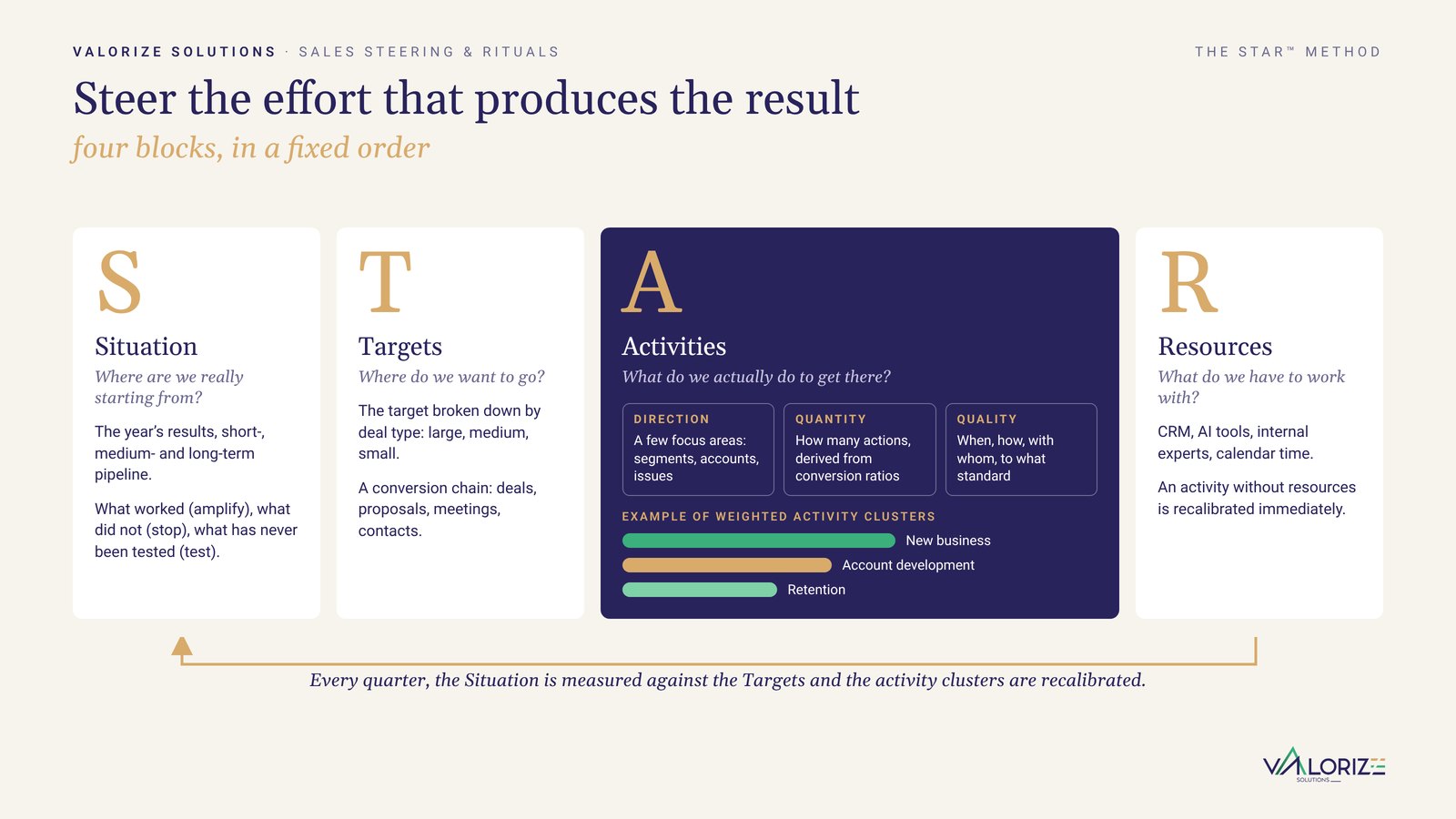
STAR™ sales steering method: Situation, Targets, Activities, Resources, Valorize Solutions

STAR™ is the Valorize Solutions steering method. It comes down to four blocks, in a fixed order: you do not define activities without knowing where you are going, and you do not talk about resources before the activities are clear.

  • Situation: where are we really starting from? The year’s results, the short-, medium- and long-term pipeline, and a clear-eyed reading of what worked, what did not work and what has never been tested.
  • Targets: where do we want to go? The target broken down by deal type, and the conversion chain that follows from it: deals, proposals, meetings, contacts.
  • Activities: what do we actually do? Four to six activity clusters, each on three axes: direction (where), quantity (how much), quality (when, how, with whom). Each cluster carries a set weight in the target.
  • Resources: what do we have to work with? CRM, AI tools, internal experts, calendar time. An activity without resources is recalibrated immediately.

The manager sets the direction of the team’s efforts: a few clear focus areas for each cluster. A precise direction (“the fifteen accounts where we have only one contact”) gives the salesperson concrete angles; a vague one sends them straight back to talking product.

Four effort indicators, readable from the first week

  • Preparation: share of priority meetings prepared with a written objective.
  • Exploration: share of priority opportunities enriched with new information about the client and its decision-making unit.
  • Progression: share of meetings that end with an explicit ask and an agreement.
  • Execution: share of actions logged with an owner and a date, and completed on time.

The indicators are read in your existing CRM, and we define them with you at the start. They give a reading well before revenue, which only reacts later.

Duration and format

Objectives

Course content

Situation, Targets, Activities, Resources, in that order. The plan is built on your current numbers and pipeline, in subgroups, from a blank page. Each group presents its plan to the others and defends it: is it solid enough to run with from Monday?

Preparation, exploration, progression, execution: for each of the four indicators, each manager works out with us which data in the existing CRM measures it, who enters it and how often, with no extra data entry where possible. They also prepare how to present the indicators to their team: these indicators are there for learning, and each salesperson reads their own first.
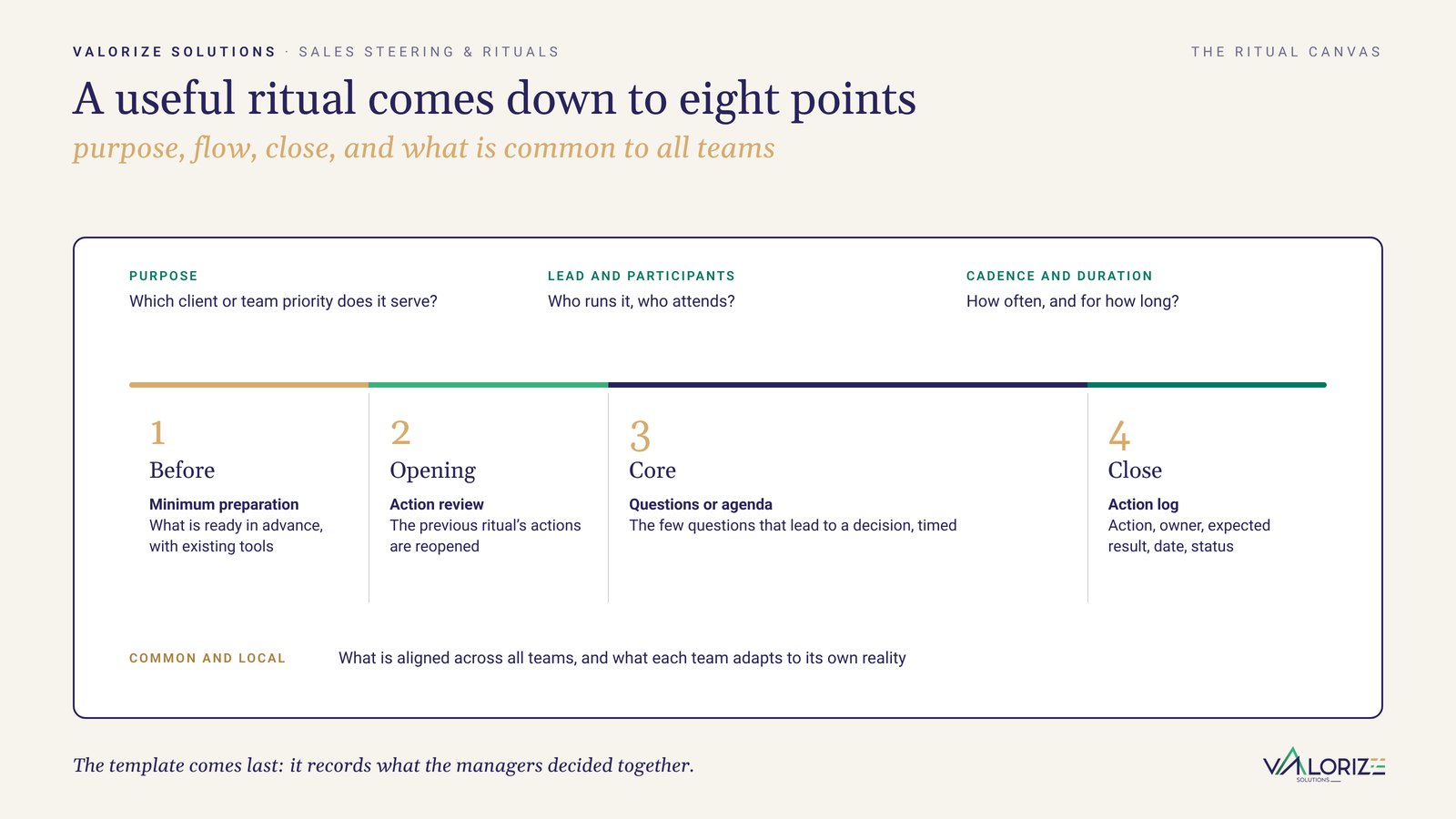
Eight-point canvas for a sales ritual, Valorize Solutions

The canvas has eight points: the purpose, the lead and the participants, the cadence and the duration, the preparation, the opening, the core of the ritual, the close with its action log, and what is common to all teams or left to each one.

Four principles guide the design: a clear purpose, linked to the STAR™ plan; a tight format that gets shorter as attendance grows; a concrete output, with every action given an owner, an expected result, a date and a status; visible value for those who attend.

  • The Monday team meeting, 45 minutes: 5 minutes on last week’s actions, 10 on STAR™ priorities and the efforts logged in the CRM, 20 on two or three client cases and their obstacles, 10 on the week’s commitments.
  • The monthly one-to-one, 30 minutes: the month’s efforts compared with the facts and the STAR™ priorities, the obstacle diagnosed, then the action the salesperson formulates.
  • The quarterly STAR™ review: the Situation measured against the Targets, the clusters that delivered, those that stalled, the ratios to correct.

A 30-minute monthly review, by account group, of the deals the company cannot afford to lose. The salesperson or the KAM leads it; the manager challenges; leadership allocates the resources.

  • Strategic stakes: what does this deal change for our position with this client, or in this market?
  • Financial stakes: how much, over what period, at what margin?
  • Timeline: what is the client’s next decision, and when?
  • Decision-making unit: who decides, who influences, who blocks, and whom have we not met yet?
  • Competitive threat: who else is in the running, and what are they competing on?
  • Resources: what does the team need to win, and who decides?

For key accounts, the module draws on our decision-making unit mapping tool. Each contact is assessed on three criteria: their influence on the decision, their attitude toward us and the intensity of our contact with them. Crossing these criteria reveals four contact profiles, each with its own action to take. The quarterly review goes back over the account plan, the offensive and defensive actions, and what remains to be opened up.

Each manager presents the first version of their STAR™ plan and their four effort indicators to their team, in a meeting that already exists. They record the actions decided in an action log: for each one, an owner, an expected result, a date and a status. They come back on day two with this log, which serves as material for designing the rituals.

If the team has a recording tool and an AI assistant, and with participants’ consent, the assistant drafts a first version of the log; the manager checks it and shares it with the team the same day.

What each manager takes away

Who should attend?

And after the training

The rituals start the following week. The quarterly STAR™ review goes back over the clusters that delivered, those that stalled and the ratios to correct.

We can observe a first real ritual and give feedback based on the facts, or support sales leadership in its first quarterly review.

This module is one of the three building blocks of the Sales Management Development Program, alongside Manage & Coach and Key Accounts. When the sales organization itself needs to be redesigned, our Advisory offer takes over.

Frequently asked questions

It is the way a manager directs, tracks and adjusts the team’s activity to reach its targets, through a fixed set of recurring rituals. A good operating rhythm tracks the efforts that produce the result, ahead of the result itself. It rests on a plan, a few indicators and rituals that actually take place.

STAR™ (Situation, Targets, Activities, Resources) is the Valorize Solutions steering method. It starts from an honest reading of the situation, translates the target into deal types, organizes activities into weighted clusters and checks that every activity has its resources. The manager can then act on what can still be changed: this week’s activity.

Effort and quality indicators, alongside the numbers: meeting preparation, account exploration, deal progression, on-time execution of actions. Four are enough to start with. They are read in the existing CRM.

Three to start with: usually the weekly team meeting, the monthly one-to-one and a review of priority deals. Other rituals are added once the first ones are firmly in place. One ritual too many, poorly run, weakens the others.

Forty-five minutes for a weekly team meeting, thirty minutes for a one-to-one or a must-win deal review. The duration goes down as the number of participants goes up. Anything that concerns only two people is dealt with after the meeting, between the two of them.

It is a short, structured monthly review of the deals the company cannot afford to lose. It covers the stakes, the timeline, the client’s decision-making unit, the competitive threat and the resources. It ends with dated actions and, if needed, a decision from leadership.

No. The module works with the tools already in place: CRM, spreadsheet, conversation recording tool, AI assistant. The minimum preparation for each ritual is defined with what already exists.

Yes, to save time on follow-up. With participants’ consent, AI and transcription tools prepare meeting notes and a first draft of the action logs; the manager checks them and keeps the judgment. The module also works without these tools.

Manage & Coach works on posture: how the manager gets the salesperson thinking and taking ownership. Sales Steering & Rituals works on steering: the plan, the indicators and the rituals where that posture is put to use. The two complement each other in the Sales Management Development Program.

Two non-consecutive days. The first covers the STAR™ method and the effort indicators, the second the rituals, the must-win deal review and the key account review. In between, each manager puts the work into practice with their team.

Pricing is tailor-made: it depends on preparation, follow-up, delivery mode, scope and complexity; the number of participants is not part of the calculation. Companies in the Belgian food industry (joint committees 118 and 220) can receive support from Alimento, for which Valorize Solutions is a recognized provider.

Discover our methodology

Let’s talk about steering your team.
Contact us