Yes, you can shorten the sessions. No, you cannot shorten the learning. Studies on attention and memory say the same thing: short formats capture attention and refresh memory, but a salesperson only changes the way they run a client conversation with practice, time to reflect and several weeks to do it in.
Short sales training: the essentials
At the end of every training course, we ask participants for feedback. It is overwhelmingly positive, and that is always good to hear. But it is the critical comments that move us forward.
One of them comes up from time to time: the pace, the length of a day in the classroom. It comes a little more often from the younger generations, who ask us for much shorter versions.
The request is legitimate. It arrives at a time when people watch entire micro-drama series on their phones, in one-minute episodes. Just one of these apps generated around $1.2 billion in spending in 2025, according to Appfigures data reported by TechCrunch.
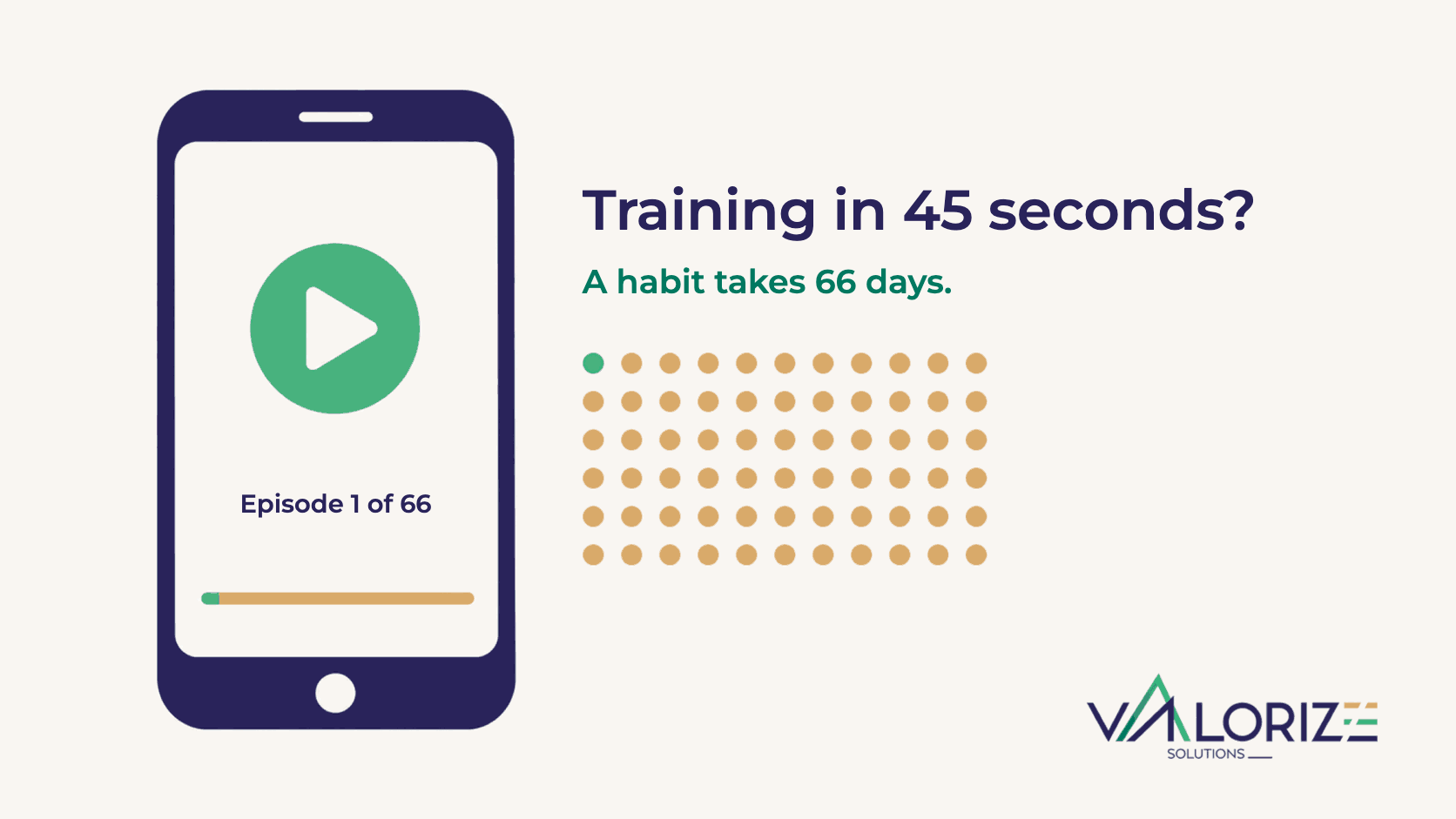
So why not sales training in 45-second episodes?
We took the question seriously. And we went to see what the research says.
Less than we are told.
The goldfish is innocent. The figure of an “8-second attention span, shorter than a goldfish’s” is attributed to Microsoft. It does not come from any of its research: it comes from an infographic with unverifiable sources.
What has changed is our relationship with the screen. Gloria Mark, a researcher at the University of California, Irvine, has spent twenty years measuring how long we stay on one screen before moving on to something else: two and a half minutes in the early 2000s, 47 seconds on average in her measurements from 2016 to 2020. She measures screen-hopping. Not the ability to concentrate in a room, with colleagues, on a real client case.
The “10-minute rule” does not hold up either. A literature review (Bradbury, 2016) concludes that the data does not support it. What makes a group’s attention vary most is the person leading the session.
Attention works in cycles. It lapses, then it comes back. And it comes back most of all just after a demonstration or a question put to the group (Bunce, Flens and Neiles, 2010).
Being active beats listening. A meta-analysis of 225 studies conducted in universities (Freeman et al., 2014) measured a 34% failure rate with traditional lectures, against 22% when students are actively involved.
So the enemy is not length. It is monotony.
That is why a day with us does not look like a lecture. Plenary, individual reflection, small-group work, reporting back, AI tools, video, recording: one activity follows another, in co-creation, on the participants’ real situations. A development lab, not a lecture room.
Two things.
Capturing attention. Across 6.9 million video sessions analysed on the edX platform, engagement tops out at six minutes, whatever the length of the video (Guo, Kim and Rubin, 2014). A short capsule will be watched to the end. The authors say so themselves: they measure viewing, not learning.
Refreshing memory. Spreading learning over time beats “all in one go”. It is one of the most robust findings in memory research, confirmed by a review of 317 experiments (Cepeda et al., 2006). And testing yourself on what you have learned anchors it better than rereading it (Roediger and Karpicke, 2006).
At Harvard Medical School, Dr Price Kerfoot turned this into a method: a few questions sent to doctors over one to two months. A wrong answer comes back a week later, a right one comes back three weeks later (Harvard Magazine, 2009).
Two minutes to reactivate a questioning technique before a client meeting: that works.
But there has to be something to reactivate in the first place.
Change behaviour.
Moving from a product-centred conversation to a conversation that brings value to the client is not a piece of information to remember. It is a habit to replace. Asking one more question instead of answering too quickly. Listening to what the client says, not to what you are going to answer. Holding a silence. Defending your value when the buyer pushes on price.
And a habit takes time. Researchers at University College London followed 96 volunteers who wanted to build a new one: it took them 66 days on average, and anywhere from 18 to 254 days depending on the person (Lally et al., 2010). The famous “21 days” are not based on any study.
And without follow-up, what has been learned erodes. According to the training managers surveyed by Saks and Belcourt (2006), 62% of participants apply what they have learned right after a training course. Only 44% still do six months later, and 34% after a year.
One last finding, with a touch of irony. In an experiment with 60 participants, scrolling through very short videos on TikTok impaired their ability to remember what they had planned to do next. Neither Twitter nor YouTube had that effect (Chiossi et al., 2023). The study is small, but it gives pause for thought: this is exactly the memory a salesperson needs to apply, the next day, what they decided in training.
Our conviction fits in one sentence: you do not change a human being’s behaviour in a few minutes, or even in a few hours.
Reflecting, in small doses. In a call centre in India, the authors of a study published by Harvard Business School asked new employees to spend the last fifteen minutes of their day writing down what they had learned. At the end of their month of training, they scored nearly 23% higher than their colleagues, who had in fact worked fifteen minutes longer every day (Di Stefano, Gino, Pisano and Staats, 2014).
Self-reflection is demanding. Nobody keeps it up for very long. But a few minutes, repeated, are enough to spark awareness. And awareness is what comes before change.
Being supported. Among 31 managers in a public agency, training alone raised productivity by 22%. Followed by eight weeks of one-to-one coaching, the gain rose to 88% (Olivero, Bane and Kopelman, 1997). The study is old and small. Its message still holds: everything is decided after the training.
Practising on the real thing. A role play prepares. A real client conversation transforms. That is why we prefer to measure, target and follow up, starting from salespeople’s real conversations.
So the question is not “long or short?” It is “which format, for which effect?”
We train face to face and remotely, synchronously and asynchronously. Each format has its role.
None of these formats is enough on its own. It is their combination that produces change, and that is what we call the hybrid format: a common foundation online before, live sessions on real deals during, a return to the exercises after, and coaching when a deal calls for it.
A training course changes nothing if it stops at the classroom door.
Here is how we respond when the request for “shorter” comes in.
And when the goal is a lasting change in the way a team sells, the journey runs over six months. That is the Sales Transformation Program: one individual session every two weeks, and two hours as a group every month.
Time in the classroom goes down. The length of the journey goes up. And the impact grows, because the practice happens where it counts: in front of the client.
We have already answered several related questions elsewhere on this site.
Want to rethink the rhythm of your sales training? Let’s talk in a first conversation.
There is no ideal length for a session, but there is a minimum length for change: allow two to three months. A new habit takes 66 days on average to form (Lally et al., 2010). Several short sequences spread over that period are better than one or two isolated days.
No. Microlearning is very effective for reactivating and memorising what has already been learned. It does not replace practice in real situations, feedback or coaching, all of which are needed to change the way a client conversation is run.
We found no solid study that demonstrates it. Content consumption habits have changed, and not only among the youngest. What makes a participant switch off, whatever their age, is passivity.
By changing activity before attention lapses: alternating plenary, individual work, sub-groups, role plays and tools. And by working on the participants’ real deals rather than on textbook cases.