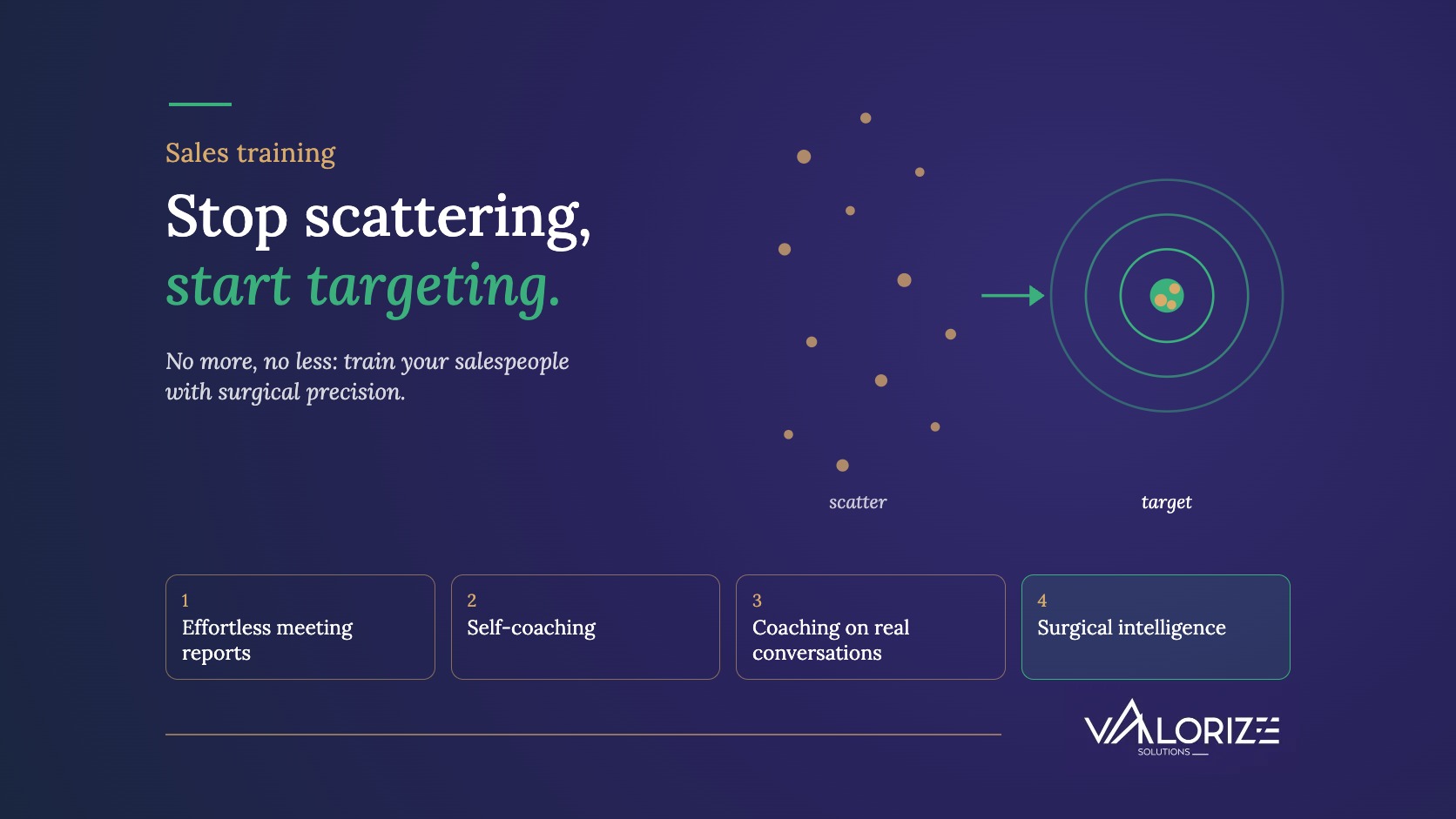
No more, no less: train your salespeople with surgical precision.
Targeted sales training: the essentials
For years, sales teams were trained somewhat blindly. Today’s tools change the game. They free up the salesperson’s attention during the conversation. And they finally make it possible to know what to train on, who, when, and with what effect.
In many organisations, sales training follows the same pattern. One programme for the whole team, the same modules for everyone. At best, a good programme. At very best, two or three levels, junior, mid-level, senior: different content, or the same content with a different level of demand.
This is not a learning choice. It is a lack of data. Neither the organisation nor the individuals know precisely what they have already worked on, and what they should be working on now.
So we spread it thin. Hours of training scattered across a range of topics, in the hope that everyone will find what they are missing. Part of the investment lands, part of it misses, and nobody really knows which.
And spreading it thin is expensive. The real cost of training is neither the trainer nor the programme. It is the hours of the people in training, away from their clients.
The point is not to do more, or to do less. It is to do it in a far more targeted way: surgically, per person or per small group. Today’s tools make that possible.
It all starts during the conversation itself. A salesperson taking notes is only half listening. And a salesperson preparing their answer while the client is speaking is not listening at all.
When the tool takes the notes, the salesperson can finally focus on the other person. On what they really say, on the words they choose, on what they leave unsaid. They become more attentive, more curious, and they get to know their clients far more deeply.
That is the first gain, and it is human before it is technical. Flawless proposals and reports are becoming the norm for everyone. What makes the difference is the quality of the conversation. That is the whole point of our Enrich Conversations module.
Most organisations stop at the first level of conversation intelligence tools such as Leexi. The real value lies in the next ones.
1. Effortless meeting reports. Notes, summary, next steps, a CRM fed from what was actually said. The salesperson reviews and validates. They save time, and admin changes in nature.
2. Self-coaching. Salespeople review their own conversations. They discover what was really said, not just what they remember. They compare themselves with themselves, month after month. It is a bit like having a personal coach always at your side, right into the client’s office.
3. Coaching. The manager or coach no longer works from impressions, but from real conversations. With their teams, they can analyse dozens of them in a few minutes, where a day in the field shows two or three.
4. Surgical intelligence. As soon as there is a little material, you know exactly what to work on. Individual and team skills, of course. But also the exact words of clients, so that marketing speaks to the market differently. And their difficulties and requests, fed back precisely to product development and R&D.
All of this, simply by listening to what clients are already telling your salespeople, every day.
With this material, training changes in nature. You no longer train broadly hoping to hit the mark. You train on what is really missing, for the right person, at the right time.
When you listen to real conversations, priorities emerge very quickly. One team asks excellent questions but gives way on price as soon as the client hesitates. One salesperson handles objections very well but never proposes a next step. One objection keeps coming back, and nobody has a real answer.
Training is then built from these findings. And above all, its application can be followed in the conversations of the following weeks. Does the technique practised in the workshop show up in client meetings? For whom? With what effect on the conversation?
At last, you measure what matters, by comparing periods:
Each measurement feeds the next step: a new finding, a new adjustment, a new measurement. That is continuous development. Not a catalogue of courses, but a loop that learns.
All of this is feasible today. The return on investment is huge: training hours that really pay off, products and marketing fed by the voice of the client.
The only risk is becoming more demanding, sharper, more effective. And regaining real attention for the client and the people around the table, instead of trying to remember everything to report back to the team once back at the office.
Transparency. With teams, who know what is recorded, why and for whom. With clients, who are told about the tool at the start of the conversation.
Measurement that does not turn into control. Individual feedback belongs to the salesperson. Management receives aggregated summaries to steer, not to monitor.
Respect for security rules. Company policies and tool choices set the framework. Within that framework, the only limit is our creativity.
For many salespeople, the CRM serves management first: pipeline, reporting, forecasts. It feels either like being watched, or like admin that gives them nothing back.
When what is really said with clients feeds it, everything changes. The salesperson prepares the next meeting better. They do not start from scratch when taking over an account. They find what the client told them six months ago. The CRM becomes a tool that serves the relationship between the salesperson, their company and their clients.
This is exactly what the four gears of our approach describe: your people, your processes, your methods and your tools. Training on its own evaporates. A tool on its own lightens the admin, nothing more. Together, they form a system that learns.
We already do this with our clients: better trained sales teams, who know their clients a little better every day, and who use their tools because they want to rather than because they have to.
Enrich the sales conversation. When reports become easy, the difference lies in what the salesperson asks, hears and helps the client put into words. That is the heart of our Enrich Conversations module.
Coach on real conversations. With Manage & Coach, we help managers set up regular coaching, based on what is really said with clients.
Think of commercial excellence as a whole. People, processes, methods and tools that drive each other: that is our Commercial excellence approach, rolled out through our seven-step methodology.
Curious to see what this would look like in your organisation? Let’s talk in a first conversation.
Because their needs are not the same. Without data, training time is spread across every topic in the hope that each person finds what they are missing. Yet the real cost of training is the hours of the people being trained.
No. It is not about doing more or less, but about training far more precisely: per person or per small group, based on findings drawn from real client conversations.
By comparing periods on qualitative criteria: the quality and depth of conversations, the actual use of the techniques practised, how objections are handled, concessions given away too easily, the value brought to the client.
Not if three conditions are met: transparency with teams and clients, individual feedback that belongs to the salesperson with aggregated summaries for management, and respect for the company’s security rules.